


بسم الله الرحمن الرحيم
All praise be to Allah, the Possessor of great bounty and blessings, the One who grants favor and honor, the Foundation who cannot be wronged, the Dignity that cannot be aspired to, and prayers and peace upon our Prophet Muhammad (saw), the best of humankind, the Seal of the great Messengers (as), and upon his family, his Companions (ra), and his noble followers, who applied the system of Islam and adhered to its rulings with utmost commitment. O Allah, make us with them, gather us in their company, and strengthen us steadfast until we meet You on the Day when feet will slip, the Day of great distress.
O Believers:
Assalamu Alaikum wa Rahmatullah wa Barakatahu,
We continue with you the series of episodes from our book “Bulugh al-Maram from the Book of the System of Islam,” and with the twenty-sixth episode, titled “Man’s Response to His Instincts and Organic Needs Contains the Potential for Good and Evil.” We contemplate what is mentioned on page twenty-six of the book “The System of Islam” by the scholar and political thinker, Sheikh Taqi ud-Din Al-Nabahani.
He (ra) said: “Though the characteristics in objects, instincts, and organic needs, which Allah (swt) predetermined within them, and also made them intrinsic, have an affect on the outcome of the action. Their characteristics by themselves do not initiate action, it is man who initiates the action when using them. Hence, the sexual inclination in the instinct of reproduction has the potential for good and bad; and the hunger present in the organic need has the potential for good and bad. However, the one who performs actions that are good or bad is man, and not the instinct or the organic need. This is because Allah (swt) created for man the mind that distinguishes and He made in the nature of the mind the quality of perceiving and distinguishing. He also guided man to know the path of good and bad,
[وَهَدَيْنَاهُ النَّجْدَيْنِ]
“And we showed him (the man) the two paths (of good and bad).” [TMQ 90:10]. Allah (swt) also created in man the ability to comprehend wickedness and piousness.
[فَأَلْهَمَهَا فُجُورَهَا وَتَقْوَاهَا]
“And He inspired it its wickedness (fujooraha) and its piousness (taqwaha).” [TMQ 91:8]. When man responds to his instincts and organic needs in a manner agreeing with the commands and proscriptions of Allah (swt), then he performs the good action and proceeds in the path of piousness. When he responds to the instincts and organic needs deviating from the commands and proscriptions of Allah (swt), then he performs the bad action and proceeds in the path of wickedness. Therefore, in all of that, the good and bad occur from and on man. He responds to the needs according to the commands and prohibitions of Allah (swt) and thus does good, or responds to them deviating from Allah’s (swt) commands and prohibitions and thus does bad.”
And we say, hoping for Allah’s pardon, forgiveness, pleasure, and Paradise: Indeed, Nuh (as) remained among his people calling them for a thousand years less fifty. This is only the period of his dawah, and we do not know how long he lived before it, nor how long he lived after it. And when he was asked: “How did you find the worldly life?” he said: “I found it like a room that has two doors; I entered through the first and exited through the second.” Come, let us live out this illustrative scene through which we aim to convey an idea to your minds. Come, let us walk with you into the empty, barren desert. Here we are walking, and after covering a great distance... we noticed from afar something resembling a structure... We kept walking until we got closer... Look closely... It is a structure resembling a small room... Let us get closer and closer... Here we are, we have approached it... It truly is a room... Let us go to it to see what it is like... Here we have arrived... But what is this that we see? It is a signboard. Let us read what is written on it: “Anyone who wishes to enter the adjacent room must read the following instructions.”
Before you, O entrant, is a room with two opposite doors: you enter through the first door and exit through the second.
You will find, O entrant, a table—that is, a table—upon which are two full cups: one is filled with honey, and the other is filled with wine.
You, O entrant, are free to take or drink from whichever of the two cups you wish.
After your exit, O entrant, through the second door, you will receive your reward as follows:
If you have partaken from the cup of honey, you will receive a valuable reward.
And if you have indulged in the wine, then severe punishment will befall you. - The scene ends and the curtain falls -.
This scene represents a vivid model and a miniature example of the worldly life that man lives. The room is the worldly life, the honey and wine are the acts of good and evil, and the reward and punishment are the recompense and the penalty. Whatever the entrant chooses, whether he chooses the wine or chooses the honey, his choice remains within and according to the will of the one who placed the wine and the honey, for if this placer had not willed for the entrant to indulge in the wine, he would not have placed it for him.
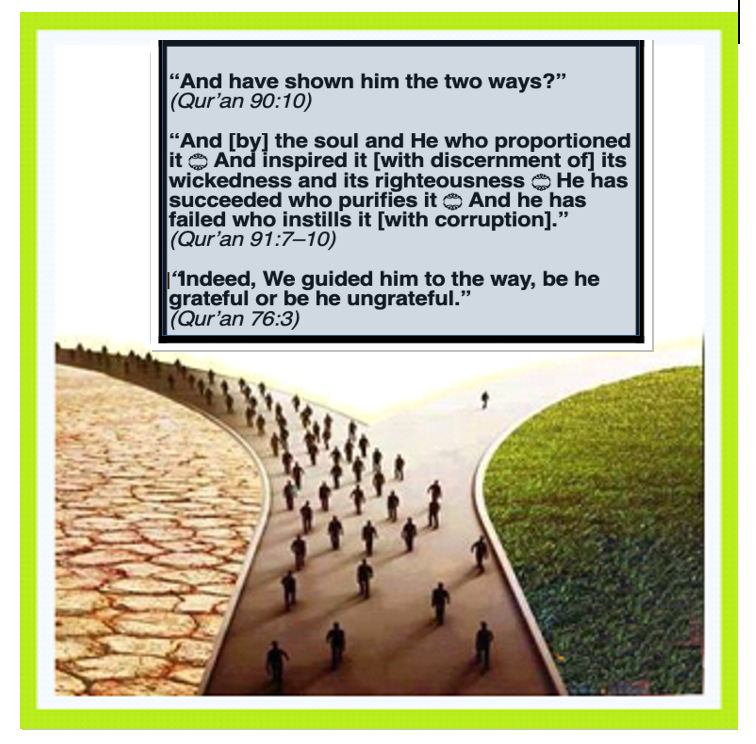
And to Allah, the Most High, belongs the highest example, for Allah, the Exalted, created man, endowed him with a thinking mind, and sent to him Messengers to clarify for him the path of good and the path of evil. Allah, Glorified and Majestic, says in His decisive, mighty Book:
[وَهَدَيْنَاهُ النَّجْدَيْنِ]
“And have shown him the two ways (of good and evil)?” [TMQ Surah Al-Balad: 10]. And He, the Almighty, says:
[إِنَّا هَدَيْنَاهُ السَّبِيلَ إِمَّا شَاكِرًا وَإِمَّا كَفُورًا]
“Verily, We showed him the way, whether he be grateful or ungrateful” [TMQ Surah Al-Insan: 3]. And He, the Exalted in Might, says:
[وَنَفْسٍ وَمَا سَوَّاهَا (7) فَأَلْهَمَهَا فُجُورَهَا وَتَقْوَاهَا (8) قَدْ أَفْلَحَ مَنْ زَكَّاهَا (9) وَقَدْ خَابَ مَنْ دَسَّاهَا]
“And by the soul and He who proportioned it. And inspired it [with discernment of] its wickedness and its righteousness. He has succeeded who purifies it. And he has failed who instills it [with corruption]” [TMQ Surah Ash-Shams: 7-10]. And Allah informed man, through the tongues of His Messengers, that if he obeys, then for him is Paradise where he will enjoy its bliss, and if he disobeys, then for him is the Fire of Hell, whose heat he will suffer. He, the Exalted, said:
[إِنَّ الْأَبْرَارَ لَفِي نَعِيمٍ (13) وَإِنَّ الْفُجَّارَ لَفِي جَحِيمٍ (14) يَصْلَوْنَهَا يَوْمَ الدِّينِ (15) وَمَا هُمْ عَنْهَا بِغَائِبِينَ (16) وَمَا أَدْرَاكَ مَا يَوْمُ الدِّينِ (17) ثُمَّ مَا أَدْرَاكَ مَا يَوْمُ الدِّينِ (18) يَوْمَ لَا تَمْلِكُ نَفْسٌ لِنَفْسٍ شَيْئًا وَالْأَمْرُ يَوْمَئِذٍ لِلَّهِ]
“Indeed, the righteous will be in pleasure. And indeed, the wicked will be in Hellfire. They will [enter to] burn therein on the Day of Recompense. And never will they be absent from it. And what can make you know what is the Day of Recompense? Then, what can make you know what is the Day of Recompense? It is the Day when no soul will possess for another soul [power to do] a thing; and the command, that Day, is [entirely] with Allah” [TMQ Surah Al-Infitar: 13-19]. Thus, the verses indicate that man, within the sphere of his control, has the choice between following the path of truth, piety, and good, and following the path of falsehood, immorality, and evil. And He, the Almighty, said, making every human being accountable and responsible for their deeds:
[كُلُّ نَفْسٍ بِمَا كَسَبَتْ رَهِينَةٌ]
“Every soul, for what it has earned, is held in pledge” [Surah Al-Muddaththir: 38]. And He also said, describing a scene from the scenes of Reckoning on the Day of Judgment:
[وَكُلَّ إِنسَانٍ أَلْزَمْنَاهُ طَائِرَهُ فِي عُنُقِهِ وَنُخْرِجُ لَهُ يَوْمَ الْقِيَامَةِ كِتَابًا يَلْقَاهُ مَنشُورًا (13) اقْرَأْ كِتَابَكَ كَفَىٰ بِنَفْسِكَ الْيَوْمَ عَلَيْكَ حَسِيبًا (14) مَّنِ اهْتَدَىٰ فَإِنَّمَا يَهْتَدِي لِنَفْسِهِ وَمَن ضَلَّ فَإِنَّمَا يَضِلُّ عَلَيْهَا وَلَا تَزِرُ وَازِرَةٌ وِزْرَ أُخْرَىٰ وَمَا كُنَّا مُعَذِّبِينَ حَتَّىٰ نَبْعَثَ رَسُولًا]
“And for every person We have fastened his fate (deeds) to his neck, and We shall bring forth for him on the Day of Resurrection a book which he will find wide open. (13) (It will be said to him:) ‘Read your book. You yourself are sufficient as a reckoner against you this Day.’ (14) Whoever is guided is only guided for [the benefit of] his own soul, and whoever goes astray only goes astray [in violation] against it. And no bearer of burdens will bear the burden of another. And never would We punish until We sent a messenger” [Surah Al-Isra: 13-15].
In the paragraph before us from the book “The System of Islam,” I have extracted for you the following ideas:
The sexual inclination present in the procreative instinct has the potential for both good and evil.
The hunger present in the organic need has the potential for both good and evil.
The characteristics of objects, and the characteristics of instincts and organic needs, do not produce an action; rather, it is the human who, when utilizing them, produces the action through them.
The one who does good and evil is the human being, not the instinct or the organic need.
Allah, the Almighty and Exalted, created for man an intellect that distinguishes.
Allah, the Almighty and Exalted, has guided man to the path of good and evil.
When man responds to his instincts and organic needs in accordance with Allah's commands and prohibitions, he has done good and walked the path of piety.
And when man responds to his instincts and organic needs while turning away from Allah's commands and prohibitions, he has done evil and walked the path of transgression.
The Messenger of Allah (saw) clarified that adultery is widespread, akin to shirk (associating partners with Allah), which hardly anyone escapes. Shirk is highly prevalent and more concealed in the souls than the crawling of an ant, as the Prophet (saw) explained. This is why Allah (swt) said:
[وَمَا يُؤْمِنُ أَكْثَرُهُمْ بِاللَّهِ إِلَّا وَهُمْ مُشْرِكُونَ]
“And most of them do not believe in Allah except while associating others with Him” [TMQ Surah Yusuf 12:106]. Imam Al-Mundhiri narrated in At-Targhib wa At-Tarhib (The Book of Encouragement and Warning), on the authority of Abu Musa Al-Ash'ari (ra), that the Messenger of Allah (saw) delivered a sermon one day and said: «أَيُّهَا النَّاسُ، اتَّقُوا هَذَا الشِّرْكَ، فَإِنَّهُ أَخْفَى مِنْ دَبِيبِ النَّمْلِ»“O people, beware of this shirk, for it is more subtle than the creeping of an ant.” A man asked him (saw), "O Messenger of Allah (saw), how can we guard against it when it is more subtle than the creeping of an ant?" He (saw) replied, «قُولُوا: اللَّهُمَّ إِنَّا نَعُوذُ بِكَ مِنْ أَنْ نُشْرِكَ بِكَ شَيْئًا نَعْلَمُهُ، وَنَسْتَغْفِرُكَ لِمَا لَا نَعْلَمُهُ» “Say: 'O Allah (swt), we seek refuge in You from knowingly associating anything with You (swt), and we ask Your (swt) forgiveness for what we do not know.’”
Similarly, adultery also comes in various forms and is widespread and concealed. Ibn Hibban narrated in his Sahih from Abu Hurairah that the Messenger of Allah (saw) said, «كَتَبَ اللَّهُ عَلَى ابْنِ آدَمَ حَظَّهُ مِنَ الزِّنَا، أَدْرَكَ ذَلِكَ لَا مَحَالَةَ: فَزِنَا الْعَيْنُ النَّظَرُ، وَزِنَا اللِّسَانِ النُّطْقُ، وَالنَّفْسُ تَتَمَنَّى ذَلِكَ وَتَشْتَهِي، وَيُصَدِّقُ ذَلِكَ الْفَرْجُ أَوْ يُكَذِّبُهُ» “Allah (swt) has decreed for the son of Adam his share of adultery, which he will inevitably encounter: the adultery of the eyes is the gaze; the adultery of the tongue is speech; the soul yearns and desires it; and the private parts either confirm this or deny it.” Many people do not commit the actual act of adultery, but they come close to it. Allah (swt) has forbidden approaching adultery and did not mention the prohibition of adultery itself in His saying:
[وَلَا تَقْرَبُوا الزِّنَا]
“And do not approach adultery” [TMQ Surah Al-Isra 17:32]. Allah (swt) did not say, "Do not commit adultery," but rather said:
[وَلَا تَقْرَبُوا الزِّنَا]
“And do not approach adultery.” This necessitates the prohibition of looking, the prohibition of speaking in a manner that raises suspicion, the prohibition of approaching and entering upon women, seclusion, mixing, and other such acts. All of this falls under what Allah (swt) has forbidden in His saying:
[وَلَا تَقْرَبُوا]
“And do not approach.” Indeed, shaking hands with a non-mahram woman is part of approaching adultery, which Allah has forbidden in this verse. And returning the greeting to a woman—when there is no suspicion—if she initiates the greeting with words, there is no harm in it. Rather, it is among what Allah has commanded in His Book, as He says:
[وَإِذَا حُيِّيتُم بِتَحِيَّةٍ فَحَيُّوا بِأَحْسَنَ مِنْهَا أَوْ رُدُّوهَا]
“And when you are greeted with a greeting, greet with a better one or return it” [TMQ Surah An-Nisa 4:86]. So, returning the greeting is not prohibited by the Shariah. Similarly, saying “Yarhamuk Allah” (may Allah have mercy on you) to one who sneezes is a right that one Muslim has over another, and it applies equally to men and women. However, what is forbidden is speech that arouses suspicion. Allah says:
[وَلَا تَخْضَعْنَ بِالْقَوْلِ فَيَطْمَعَ الَّذِي فِي قَلْبِهِ مَرَضٌ]
“And do not be soft in speech [to men], lest he in whose heart is a disease should be moved with desire” [TMQ Surah Al-Ahzab 33:32].
The same applies to entering upon women and being alone with them; it is authentically reported that the Prophet (saw) said: «إِيَّاكُمْ وَالدُّخُولَ عَلَى النِّسَاءِ» “Beware of entering upon women.” They asked, “O Messenger of Allah (saw), what about the in-law [such as the husband's brother]?” He (saw) replied, «الحَمُو المَوتُ» “The in-law is death.” Regarding a person's share in zina (illicit sexual intercourse): if every glance at a forbidden person were included in this, it would pose a problem and cause harm to people. However, Allah (swt) has permitted the first glance, as the Prophet (saw) said: «يَا عَلِيُّ لا تُتْبِعِ النَّظرَةَ النَّظرَةَ, فَإِنَّمَا لَكَ النَّظرَةُ الأُولَى» “O Ali, do not follow one glance with another; for the first glance is yours [permissible], but not the second.” That is why he (saw) said, «وَالفَرْجُ يُصَدِّقُ ذَلِكَ أو يُكَذِّبُهُ» “And the private part confirms that or denies it.” The witness that testifies whether this is from zina or not is the private part. If it confirms it, it means the person – we ask Allah for safety and well-being – has fallen into what Allah has forbidden for him. And if it denies it, it means that at that time he has not committed what Allah has forbidden him. Similarly, with listening (to a non-mahram woman), if it is from zina, its sign and witness is that the private part confirms it; and if it does not, then it has denied it, meaning he has not done what is forbidden for him. As for teaching women and gathering them: this is from the established Sunnah of the Messenger of Allah (saw), and it is far from suspicion. However, the problem lies in being alone with a non-mahram woman, entering upon her, and mixing with non-mahram women without a need sanctioned by the Shariah.
O Believers:
We will conclude at this point in this halaqah. Our next time with you, Inshallah Taala, will be in the following episode. Until then, and until we meet you again, may you always be in the care, protection, and security of Allah (swt). We ask Allah, the Blessed and Exalted, to honor us with Islam, to honor Islam through us, to grant us with His victory, to give us the joy of witnessing the establishment of the second Khilafah Rashidah (rightly guided Caliphate) on the method of the Prophethood in the near future, and to make us among its soldiers, witnesses, and martyrs. Indeed, He is the Protector and the Capable of this. We thank you.
Wasalaamu Alaikum wa Rahmatullah wa Barakatahu